 MC Grating
Material Editor
This documentation was written for releases up to 2018 and is being revised. Some dialogs have changed since. If something does not match what you see, write to mc@mcgrating.com.
This dialog window is accessible from the Material Dialog.
Three models of refraction index wavelength dependence are implemented: Drude, Schott, Sellmeier, Herzberger, and Table. The Drude and Table models are complex, the Schott, Sellmeier, and Herzberger models are real valued.
The Drude model requires two parameters. The index of refraction n is given as
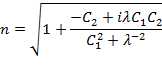
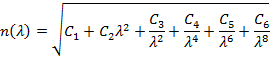
The Schott, Sellmeier, and Herzberger formulas are defined by six parameters. These formulas assume that imagine part of refractive index is identically 0, and gives n according to formulas.
The Schott formula
The Sellmeier formula
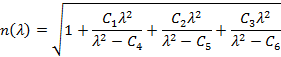
The Sellmeier coefficients for many common optical materials can be found in the online database of https://RefractiveIndex.info.
The Herzberger formula
 , where
  .
.
The Table needs at least one data point. For two points in Table the linear approximation is used to calculate refractive indexes. If number of points exceeds two the parabolic approximation is used.
By default the Material Catalog contains the data for calculation of Air refractive index by special formula:
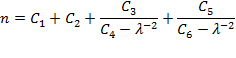
Coefficients in Material Catalog for all formulas above assume that the wavelength is in micrometers.
The following dialog window items need explanation:
- Minimum and Maximum wavelength edit controls define the wavelength range where the Table and formulas are applicable. Outside this range the refractive index will be set to the value at the nearest wavelength limit. For the Table the Minimum and Maximum wavelength controls are disabled and display the minimum and maximum wavelengths in the Table.
- Convert button allows the user to convert a Table data into a new Material Catalog record of formula presentation.
For Drude formula the Table should contain at list one point and coefficients are calculated for every Table point between Minimum and Maximum wavelengths followed by an averaging.
The Schott, Sellmeier, and Herzberger formula coefficients are calculated assuming minimum square deviation of formula and Table refractive index values between Minimum and Maximum wavelengths. In this case the Table should contain at list six points. - Ok applies all changes in this dialog and closes it.
The Table data will be automatically sorted in wavelength ascending order. - Cancel abolishes all changes in this dialog and closes it.
This dialog was used in composition of the main materials catalog and the following sources were used to retrieve some refractive index values:
- From the reference book Physical values, ENERGOATOMIZDAT, Moscow (1991)
Reference in catalog: (Table Ru) and (Schott Ru). - From GratingSolver 4.20 Demo, http://www.gsolver.com
Reference in catalog: (Table GS) and (Drude GS). - From the website http://www.luxpop.com/#index%20of%20refraction%A0
Reference in catalog: (Table). - From the paper in Applied Optics Vol. 32 No. 28 p.5587 (1993)
Reference in catalog: Film (Table). - From the website https://RefractiveIndex.info
Reference in catalog: (Sellmeier).
From the in-application help of Modal Collinear and Modal Conical, documented through 2018. If you publish results computed with MC Grating, see how to cite it.